
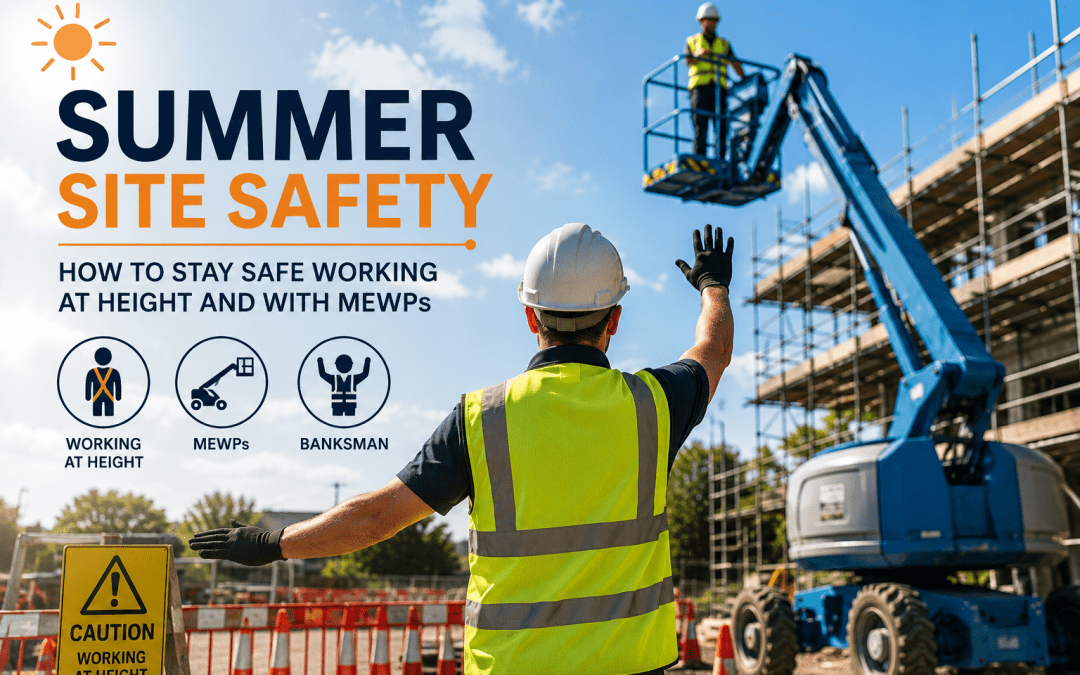
Working at height, MEWPs and banksman: summer site safety essentials
Summer brings longer days, tight programmes and more people on site. That combination can raise the risk profile, especially around three areas that consistently cause serious incidents: working at height, mobile elevating work platforms (MEWPs) and vehicle movements. If you have new starters, agency labour or returners covering holidays, getting the basics right quickly is essential.
This guide bundles the core points your supervisors and operatives need to remember, with clear routes for fast awareness training and when to step up to practical certification. Use it as a briefing, then plug gaps with short, tutor-led online modules that fit inductions and refreshers.
What counts as working at height and the 2‑metre myth
Under the UK Work at Height Regulations 2005, working at height means any work where a person could fall a distance liable to cause personal injury. It includes work above ground, at ground level near an edge or opening, and below ground where you could fall into a hole or service void. There is no blanket threshold that makes it safe until 2 metres. The so-called 2 metre rule is a myth. Even short falls can be life changing.
Best practice follows the hierarchy of control:
- Avoid work at height wherever you can. For example, assemble items at ground level or use extendable tools from a safe position.
- Prevent a fall where you cannot avoid height. Use collective protection such as guardrails, working platforms and properly erected scaffolds. Select suitable MEWPs for the task and surface.
- Mitigate the consequences if a fall occurs. Use nets, airbags, or, where justified by a task-specific risk assessment, personal fall protection.
Plan the work, choose the right equipment, keep it inspected and maintained, and ensure competent supervision. Short, targeted theory can help supervisors and operatives recognise when a task drifts into height work and how to pick safer controls. Safeguard E-Learning’s working at height training is designed for exactly that awareness.
MEWP basics, awareness vs IPAF, and harness use
MEWPs are versatile, but they are not plug-and-play. Site leads should separate three learning needs:
- Awareness training: covers legal duties, selection of MEWP categories, ground conditions, stability, pre-use checks, safe systems of work and rescue planning. Awareness is suitable for managers, planners and those who oversee MEWP tasks, and for operatives as pre-learning. It does not qualify someone to operate.
- Operator training and assessment: formal, practical instruction on the specific category of MEWP, such as Mobile Vertical (3a, scissor) or Mobile Boom (3b, cherry picker). In the UK, many sites standardise on International Powered Access Federation (IPAF) training, but the law requires competence, not a particular brand. Partner-delivered IPAF training provides recognised operator cards with expiry dates and category codes.
- Familiarisation: even trained operators need familiarisation on the specific model on site, including controls, emergency lowering and rescue arrangements.
On harnesses in MEWPs, Health and Safety Executive (HSE) guidance is often summarised as follows:
- Boom-type MEWPs (articulating or telescopic) typically require a full-body harness with a short adjustable lanyard attached to the designated anchor point to restrain the user within the basket. This helps prevent ejection in a catapult or collision event.
- Scissor lifts (vertical MEWPs) generally do not require a harness by default because the guardrails provide collective protection. However, a risk assessment may still justify a restraint system in unusual situations, such as potential for overreaching, rough terrain or wind exposure.
Can untrained operators use a MEWP? No. Only competent people who have received appropriate training, plus task and site familiarisation, should operate a MEWP. Awareness alone is not enough for hands-on operation.
How long does a MEWP certificate last? IPAF PAL cards currently last 5 years for most categories. Always check the exact course and issuing body. Refresher intervals can be shorter where risk, infrequency of use or incident history warrants it.
If you need to move quickly on route planning and roles, our partner-delivered ipaf training and mewp course pages outline practical options, including IPAF 1b and other categories.
Banksman responsibilities and standard signals
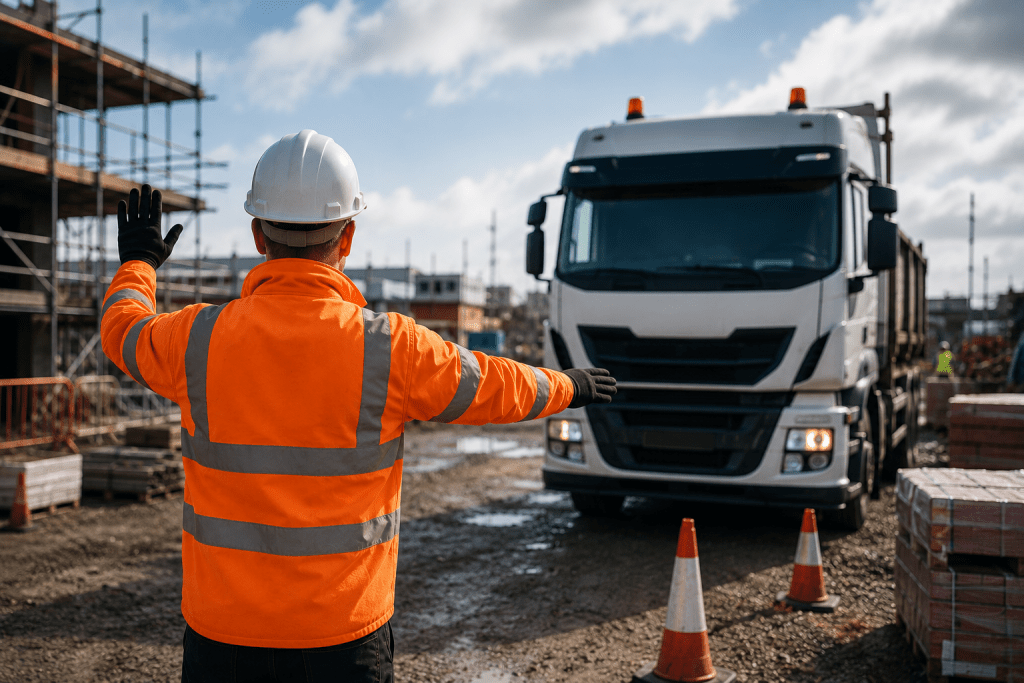
Vehicle and plant movements are a summer hotspot for incidents, particularly reversing strikes in tight compounds. A trained banksman is responsible for guiding safe vehicle movements where the driver’s view is restricted, helping maintain exclusion zones, and stopping operations when conditions are not safe.
Key duties include:
- Planning and agreeing the manoeuvre with the driver before movement.
- Wearing high‑visibility PPE and standing in a safe position with clear escape routes.
- Using standard, agreed hand signals that drivers know in advance.
- Maintaining line of sight with the driver and stopping the vehicle if contact is lost.
- Keeping pedestrians and other vehicles out of the manoeuvring zone.
Standard signals should be briefed and consistent across the site. Common examples include:
- Stop: one or both arms raised, palms facing the driver.
- Move straight: arms in front of body, palms inward, drawing back and forth.
- Left or right turn: arm extended to the side pointing in the intended direction, with the opposite arm moving to indicate the turn.
- Slow: arms making slow downward motions, palms down.
- Come towards/away: beckoning gestures toward the body or pushing away motions.
If your teams need a fast theory uplift, our tutor-led Banksman awareness explains roles, signals and safe systems, and it works well in inductions and briefings.
Where online awareness fits and when to add practical certification
Online tutor-led awareness is ideal for:
- Inductions for temporary or seasonal staff who must understand the rules before setting foot on site.
- Annual or 2 to 3 year refreshers for established workers, adjusted to your risk profile.
- Supervisors who plan or oversee tasks and need to recognise when to escalate controls.
Use awareness to set the legal framework, hazard recognition and selection of controls. Add practical certification when people perform the task hands-on or manage high-risk operations:
- Working at height awareness for planners and teams, plus on-site demonstrations and toolbox talks for task specifics.
- Banksman awareness plus supervised on-site practice in the actual yard layout before solo deployment.
- MEWP operator training through an accredited partner for anyone who will drive or operate the platform, with model-specific familiarisation at site.
You can preview the first module of our online working at height course free before rollout. For operator categories and test centres, see our ipaf course options delivered with partners.
Quick pre-holiday shutdown checklist
- Close out or downstage height tasks. Remove temporary access equipment or secure it to prevent unauthorised use.
- Park and isolate MEWPs on firm level ground, booms stowed. Remove keys, check chargers and weather protection.
- Confirm banksman coverage for any late deliveries and mark clear exclusion zones with signage and barriers.
- Review rescue plans for MEWPs and ensure emergency lowering instructions are posted at the base.
- Brief stand-ins and supervisors on site rules, key contacts and permit status. Record who holds the on-call phone.
- Check expiry dates for critical cards and awareness certificates. Schedule refreshers for the first week back, not the last day before leave.
Short, trusted routes to training
- Working at height awareness: practical, tutor-led video modules that cover the hierarchy, selection of equipment and planning. See our working at height training to start today.
- Banksman awareness: clear roles, signals and yard controls for safe vehicle movements.
- MEWP operator training: choose accredited partner delivery by category, including IPAF. See our ipaf training and mewp course pages for options and availability.
Related essentials that round out your training matrix include health and safety training for broad legal duties and manual handling course online for common site tasks.
FAQ
- What qualifies as working at height? Any task where a person could fall far enough to be injured, including at ground level near edges or openings. There is no universal 2 metre safe threshold.
- What is best practice for working at height? Follow the hierarchy: avoid, prevent, then mitigate. Plan the work, select the right equipment, maintain it, and ensure competent supervision.
- Do you need a harness in a scissor lift? Typically no, because guardrails offer collective protection. A task-specific risk assessment may still require a restraint system. Boom-type MEWPs normally require a full-body harness with a short lanyard attached to the basket anchor.
- Can untrained operators use a MEWP? No. Only trained and competent operators with familiarisation for the model and site should operate a MEWP.
- How long does a MEWP certificate last? Many IPAF PAL cards last 5 years. Check the issuing body and category for exact validity.
- What does a banksman do and what are the standard signals? A banksman plans and controls vehicle movements where vision is restricted, keeps zones clear and uses agreed hand signals such as stop, slow, straight, and left or right turn.
Summary and next steps
Busy summer schedules increase exposure to height, powered access and vehicle movement risks. Close the gaps quickly with clear rules, competent people and simple, repeatable systems. Use online awareness to brief teams fast, then add hands-on certifications where the job demands it.
Ready to move? Start your working at height course today, add banksman training to inductions, and explore partner-delivered options on our ipaf course page for MEWP operators. If you are building a wider matrix for new starters, our health and safety training and manual handling course online can help you cover core duties alongside task-specific learning.
Banksman Training:
Banksman Training - Safeguard E-Learning
Working at Height Training:
Working at Height - Safeguard E-Learning
Workplace Health & Safety Training:
Workplace Health and Safety - Safeguard E-Learning
Provision and Use of Work Equipment Regulations (PUWER) Training:
Provision and Use of Work Equipment Regulations (PUWER) - Safeguard E-Learning
Lifting Operations and Lifting Equipment Regulations (LOLER) Training:
Lifting Operations and Lifting Equipment Regulations (LOLER) - Safeguard E-Learning
Other Health & Safety Courses:
Health & Safety Courses - E-Learning - On-Line Fire and Health & Safety Courses
For questions or support with rollouts, contact Safeguard E-Learning on 0333 366 1015 or info@safeguardconsultancy.co.uk. The first module of every course is free to preview.